Model, forecast and simulate business processes for improved strategic and tactical planning.
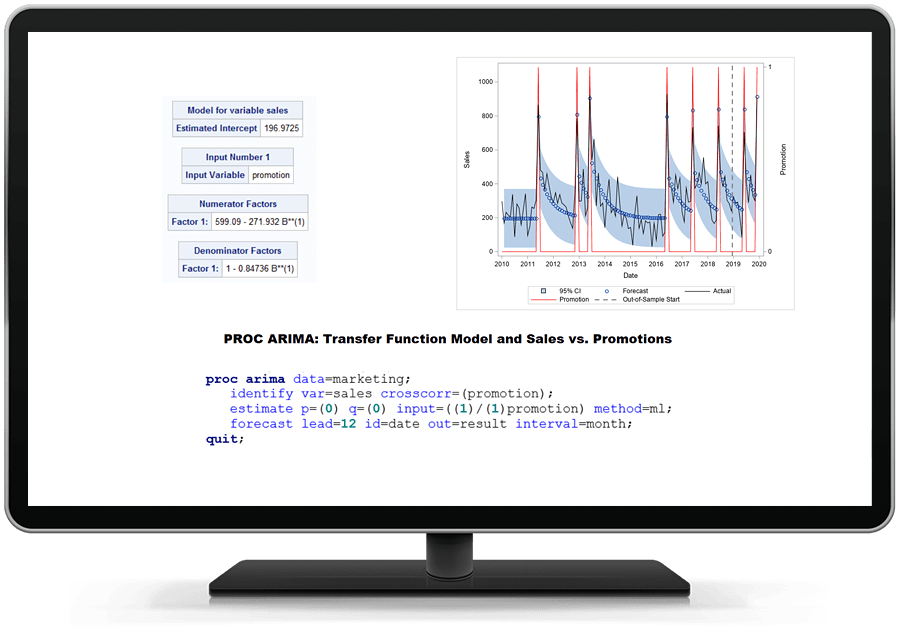
Analyze the impact of promotions and events.
Determine the effectiveness of promotions and events so you can better allocate marketing dollars in the future. Model demand based on marketing or media mix activities that measure the impact of pricing, advertising, in-store merchandising, store distribution, sales promotions and competitive activities. Use simulation and optimization tools to make investments that will drive profitable volume growth.
Model customer choices and price elasticities.
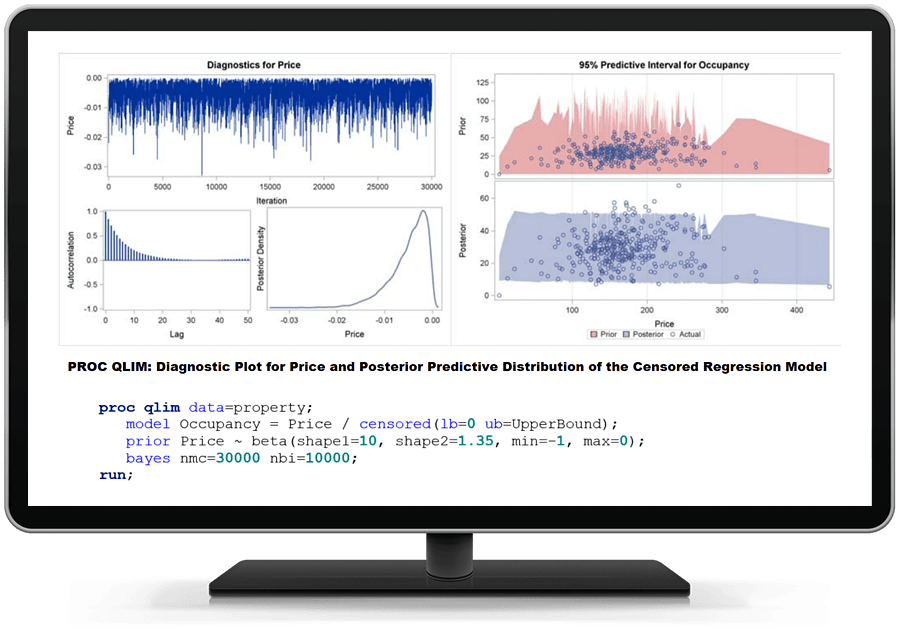
Get the most out of your marketing efforts by understanding which product features appeal to a particular audience. Modeling customer choices based on their attributes helps improve strategy by predicting customer decisions. By understanding these choices and the factors that influence them, you can adjust marketing strategies or fees to target the right population.
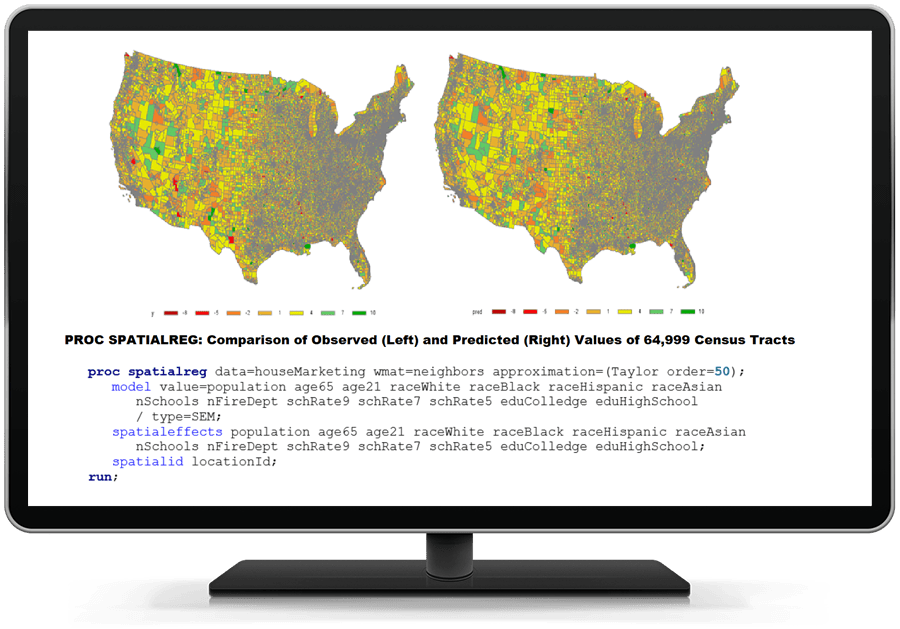
Perform spatial regression and make accurate predictions.
Eighty percent of all the data in the world has some spatial components, and SAS/ETS enables you to easily handle spatial interaction and spatial heterogeneity in a regression setting. You can efficiently process big data with thousands of locations – or more. By embracing the spatial information, you can confidently make the correct interpretation, prediction or decision.
Model risk factors and predict economic outcomes.
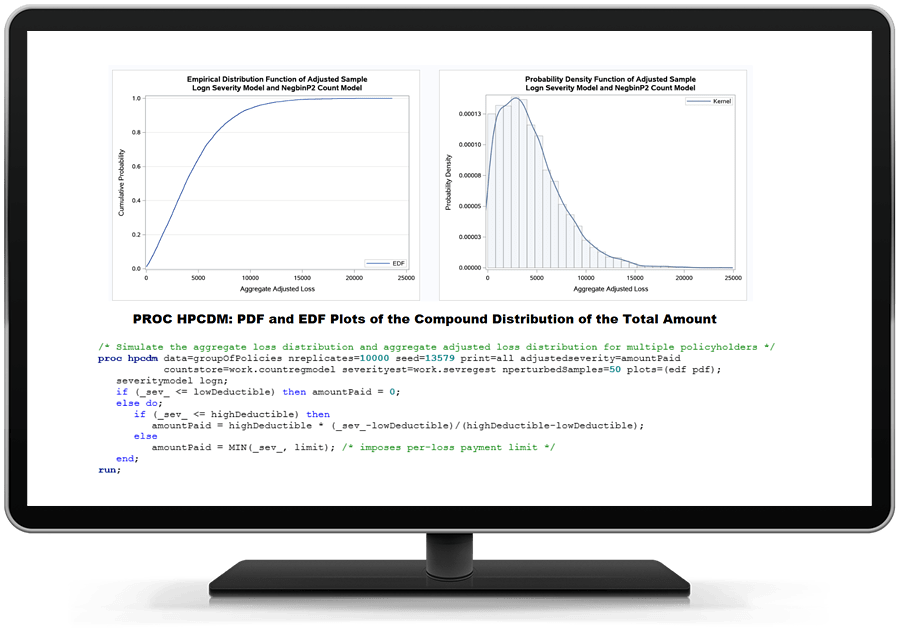
Copula methods and compound distribution modeling let you model multivariate dimensions of risk factors. This is valuable when you have to model many correlated risk factors that are non-normally distributed. SAS/ETS can fit probability distributions for the severity (magnitude) of random events – e.g., the distribution of insurance claims.
Make better staffing decisions.
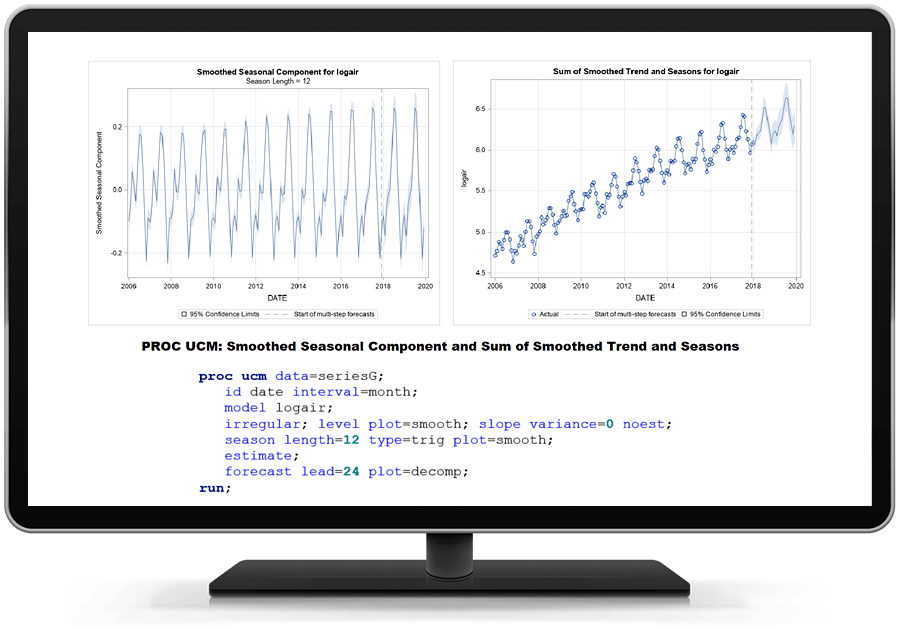
Forecast demand for services so you can allocate staff resources appropriately. Automatically account for seasonal fluctuations and trends, and select the best method for generating the demand forecasts. Efficient staff allocations enable you to meet customer needs with no wasted resources.
Forecast volatility and devise trading strategies.
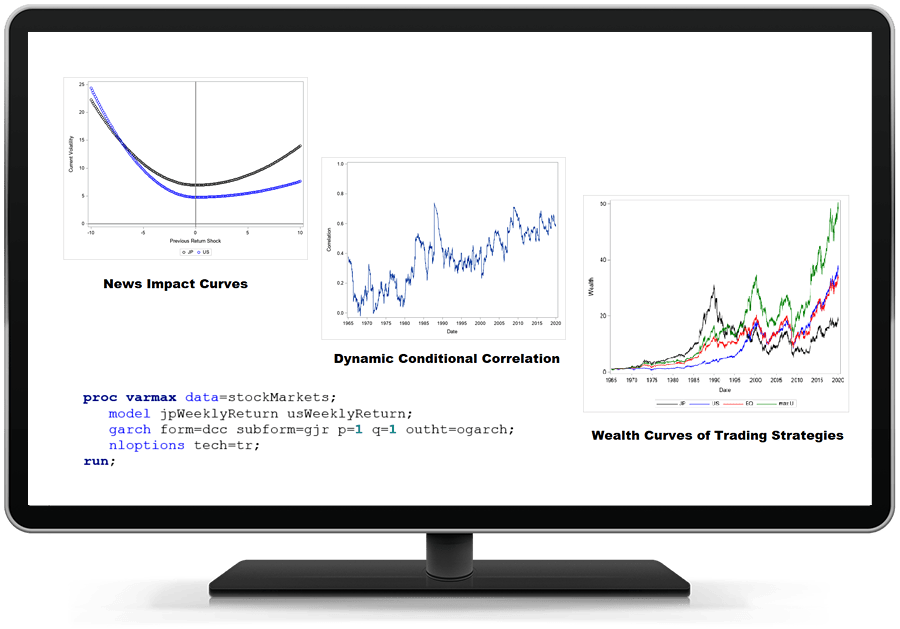
Volatility forecasting is difficult, but it's critical in risk management, asset pricing and portfolio optimization. SAS/ETS makes volatility forecasting easy using different types of GARCH models. You can devise trading strategies based on your forecasting and portfolio-optimization criteria.
KEY FEATURES
Economic and market conditions, customer demographics, pricing and marketing activities can all affect your organization. Our econometric capabilities, time series analysis and time series forecasting techniques can help you understand those factors and improve your strategic and tactical planning.

High-performance econometrics
Provides high-performance procedures for loss modeling, count data regression, compound distribution, Copula simulation, panel regression, and censored and truncated regression models. Censored and truncated models also allow for Bayesian estimation.
Cross-sectional econometric methods
Enables time series cross-sectional analysis and spatial econometric models for cross-sectional data where observations are spatially referenced or georeferenced.
Time series analysis
Helps you uncover and quantify previously undetected trends using graphical and analytical exploration capabilities for time-recorded data.
Forecasting methods
Provides a broad array of methods, including regression, unobserved components models, trend extrapolation, exponential smoothing, Winters’ method, ARIMA (Box-Jenkins), and dynamic or transfer function models.
Singular spectrum analysis
Decomposes a time series into additive components and categorizes them based on the magnitudes of their contributions.
Similarity analysis for sets of time series
Computes similarity measures for transactions with respect to time by accumulating the data into a time series format. Computes similarity measures for sequences by respecting the ordering of the data.
State space modeling
Enables linear state space modeling and forecasting of time series and longitudinal data, with enhanced capabilities for analyzing panel data.
Simulation for strategic forecasting & planning
Provides a variety of means for modeling business processes within what-if and Monte Carlo simulation analyses.
Severity of events modeling
Includes predefined models for commonly used distributions (Burr, exponential, gamma, inverse Gaussian, lognormal, Pareto, generalized Pareto and Weibull).
Data management & preparation
Converts time series from one sampling frequency to another, interpolates missing values and aggregates transactional data into time series. Includes more than 100 time series transformation operations.
Specialized access to commercial & government databases
Lets you extract data directly from files supplied by government and commercial data vendors and then converted to SAS data sets.
Explore More on SAS/ETS® Software & Beyond

BLOG SERIES
Applied Econometrics
Learn the 10 commandments of applied econometrics, or how not to sin when working with real data.

COMMUNITY
Ask questions, share tips and more in the SAS Forecasting and Econometrics Community.

INSIGHTS
Analytics Insights
Get the latest analytics news, views and best practices from the brightest minds in the business.