SAS® Banking Analytics Architecture
Ensure consistency, reduce costs and data preparation time, and enable users to make fact-based decisions
Inconsistent, incomplete and inaccurate data spread across multiple operational systems, such as deposits, loans and wealth management, often results in banking executives making business decisions based on "gut feel" rather than reliable analysis. What if you could consolidate data across the institution and make it easily accessible for analytics and reporting, so you could ensure consistency, reduce costs and data preparation time, as well as enable users to make fact-based decisions? You can.
Benefits
- Deliver information that's consistent, accurate, verifiable and up-to-date.
- Gain a complete, integrated view of all your enterprise data.
- Always have access to the data you need, when you need it.
- Provide clear, structured information to all who need it.
- Eliminate overlapping, redundant tools and systems with one solution.
How SAS® Is Different
- Only the SAS Banking Analytics Architecture lets you reduce costs and implementation time with banking-specific logical and physical data models and prebuilt ETL functionality.
- Superior data management capabilities give you confidence in your data's integrity by letting you consolidate data from multiple legacy systems into a single version of the truth and automatically validating data as part of the data integration process.
- The SAS Banking Analytics Architecture lowers your total cost of ownership by providing a single, unified environment for integrating, sharing, centrally managing and using data.
Benefits
- Deliver information that's consistent, accurate, verifiable and up-to-date. SAS Banking Analytics Architecture lets you access accurate data consistently, when and where it is needed, giving you increased confidence in the accuracy and timeliness of your data.
- Gain a complete, integrated view of all your enterprise data. A comprehensive data dictionary covers all key banking subject areas, including customers, products, instruments, customer analytics, financial accounting and risk management. Predefined logical and physical data models serve as a single version of truth, standardizing more than 8,000 banking data elements to ensure consistent terminology and reporting throughout the organization.
- Always have access to the data you need, when you need it. From older, legacy core banking or loan origination systems to the latest online banking or wealth management platforms, SAS Banking Analytics Architecture can access and process data from virtually any hardware platform or operating system. As a result, you'll save time, shorten the learning curve and give decision makers the information they really need.
- Provide clear, structured information to all who need it. SAS Banking Analytics Architecture provides a full breadth of business intelligence capabilities and includes an easy-to-use, Web-based reporting environment for easily communicating critical business information to the right people within your organization.
- Eliminate overlapping, redundant tools and systems with one solution. SAS Banking Analytics Architecture is a flexible, reliable and complete solution that eliminates the piecemeal approach of linking and managing technologies from different vendors. It provides lower overall cost, reduced risk and faster results.
Features
- Banking data model
-
- Serves as a single version of the truth, covering all key banking subject areas, including banking, investment and insurance accounts.
- Stores historical information at a granular level.
- Provides a comprehensive dictionary that describes banking data elements.
- Maps all physical data structures to business terms.
- Includes both logical and physical data models – e.g., ERwin data models and SAS metadata.
- Can be deployed in multiple databases, including SAS, Microsoft SQL Server, Oracle, Teradata and DB2.
- Provides business data definitions that address the needs of global banking institutions with multiple lines of business, including consumer, corporate, mortgage lending, wealth management and investment banking.
- Supports a variety of business analytics for marketing, finance, risk and compliance.
- Data management
-
- Accesses data from virtually any system in any form, including unstructured and semistructured data.
- Embeds data quality into all processes.
- Cleanses data in native languages, with specific language awareness and localizations for more than 20 worldwide regions.
- Contains customized and reusable data quality business rules that can be accessed directly within process job flows.
- Handles data migration and synchronization federation projects.
- Includes wizards for accessing source systems, creating target structures, importing and exporting metadata, and building and executing data extraction, transformation and loading (ETL) process flows.
- Provides a dedicated GUI for profiling data and identifying and repairing source system issues, while retaining the business rules for later use in the ETL processes.
- Has enterprise connectivity to data sources - ODBC, IBM DB2/UDB, Microsoft Access and Excel, Microsoft SQL Server, Netezza, Oracle, Sybase, SAS, Teradata, banking core systems and more.
- Uses out-of-the-box standardization rules to conform data to corporate standards, and lets you build customized rules for special situations.
- Migrates or synchronizes data between database structures, enterprise applications, mainframe legacy files, text, XML, message queues and a host of other sources.
- Joins data across sources for real-time access and analysis.
- Reporting and business intelligence
-
- Provides a Web-based, interactive reporting interface for business users.
- Includes query capabilities for all levels of users across multiple BI interfaces.
- Slices and dices multidimensional data using a special slicer dimension and by applying filters on any level of a hierarchy.
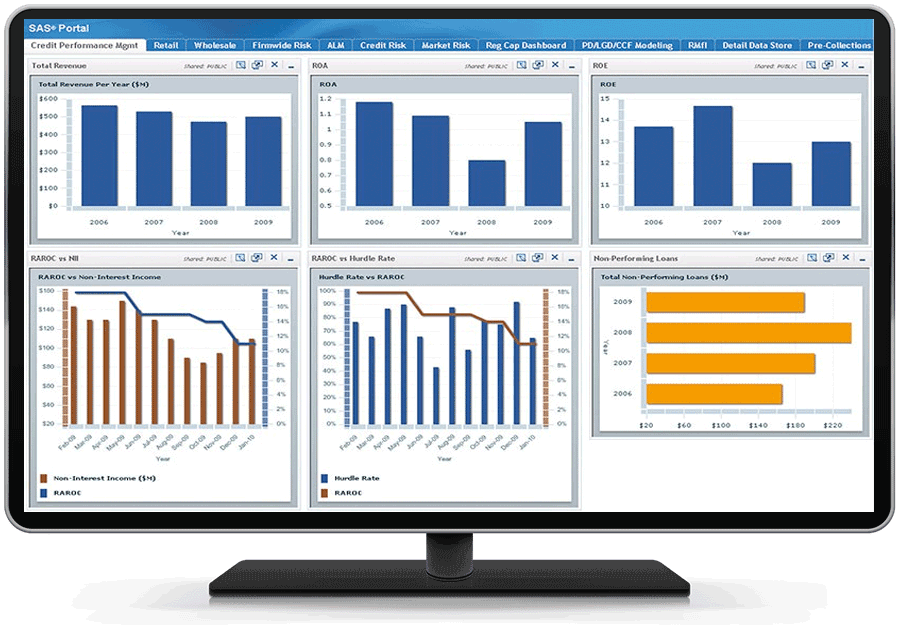
- Displays performance results via critical first-alert, call-to-action dashboards.
- Provides dynamic business visualization tools for interactive data exploration, visual queries and more.
- Includes access to SAS capabilities for data access, reporting and analytics directly from Microsoft Office, including Word, Excel and PowerPoint.
- Enables wizard-driven report creation within Microsoft Office tools.
Screenshots
System Requirements
Client environment
- Windows 32- and 64-bit
Server environment
- Windows 32- and 64-bit
- Solaris (SPARC and x86-64)
- HP-UX (PA RISC and Itanium)
- AIX
- LINUX 32- and 64-bit
Middle tier
- Windows 32- and 64-bit
- Solaris (SPARC and x86-64)
- AIX
- Linux 64-bit
- HP-UX Itanium
Ready to learn more?
Call us at 1-800-727-0025 (US and Canada) or request more information.