This Chartis RiskTech report recognizes SAS' strengths to include solutions for:
- Asset & liability management (ALM)
- Funds transfer pricing (FTP)
- Liquidity risk management (LRM)
- Capital and balance sheet optimization
- Hedging and risk management
- Financial planning and budgeting
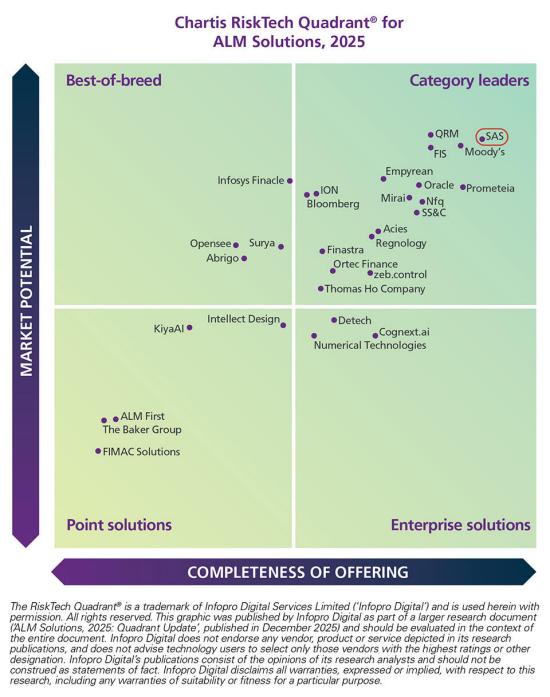
SAS is a long-standing partner of financial institutions, including global systemically important banks (G-SIBs). SAS' ALM solutions provide a broad range of integrated capabilities in data management, modeling, simulation and reporting, supported by the highly scalable power of cloud-native computing technology." Chartis Research
Explore more SAS resources
To browse resources by type, select an option below.
-
- Select resource type
- ARTICLE
- Benchmark Brief
- BLOG POST
- COMMUNIQUÉ DE PRESSE
- Description de la solution
- Ebook
- ÉTUDE DE CAS
- Executive Brief
- Extrait du livre
- Infographie
- Interview
- Livre blanc
- Podcast
- PRÉSENTATION DES SERVICES
- RAPPORT D'ANALYSTE
- Recherche
- Série
- Série de podcasts
- Solution Brief
- Témoignage client
- Témoignage client
- Vidéo
- Vidéo
- Webinaire
-
 Livre blanc
Modernizing Asset Liability Management
Livre blanc
Modernizing Asset Liability Management -
 Témoignage client
Strengthening information security and governance with unified risk management
Témoignage client
Strengthening information security and governance with unified risk management -
 ARTICLE
Next generation anti-money laundering: robotics, semantic analysis and AI
ARTICLE
Next generation anti-money laundering: robotics, semantic analysis and AI -
 Témoignage client
UK bank uses advanced analytics to reduce risk and cloud costs
Témoignage client
UK bank uses advanced analytics to reduce risk and cloud costs -
 Webinaire
Strengthening Deposits Through Predictive Churn Modeling and Improved Customer Engagement
Webinaire
Strengthening Deposits Through Predictive Churn Modeling and Improved Customer Engagement -
 ARTICLE
A new arms race: Analytics for commodity market compliance
ARTICLE
A new arms race: Analytics for commodity market compliance -
 Témoignage client
Automating credit decisions for a digital-first future
Témoignage client
Automating credit decisions for a digital-first future -
 Livre blanc
Stress Testing 2.0: Better Informed Decisions Through Expanded Scenario-Based Risk Management
Livre blanc
Stress Testing 2.0: Better Informed Decisions Through Expanded Scenario-Based Risk Management -
 Ebook
5 Steps to a Unified Enterprise Customer Decisioning Strategy
Ebook
5 Steps to a Unified Enterprise Customer Decisioning Strategy -
 Livre blanc
The road to integration
Livre blanc
The road to integration -
 Ebook
Supercharge your ALM system: How treasury and finance departments can empower banks to brace for the unexpected
Ebook
Supercharge your ALM system: How treasury and finance departments can empower banks to brace for the unexpected -
 Témoignage client
Transforming asset and liability management for a new era of banking
Témoignage client
Transforming asset and liability management for a new era of banking -
 Webinaire
2025 Trends in Global Banking
Webinaire
2025 Trends in Global Banking -
 Webinaire
Beyond the Tipping Point: Tackling Interest Rate and Liquidity Risk for Future-Ready Banking
Webinaire
Beyond the Tipping Point: Tackling Interest Rate and Liquidity Risk for Future-Ready Banking -
 ARTICLE
New attitudes for liquidity risk management
ARTICLE
New attitudes for liquidity risk management -
 Ebook
The strategic bank playbook: Transforming insights into impact
Ebook
The strategic bank playbook: Transforming insights into impact -
 ARTICLE
Beyond IFRS 17 – what's next?
ARTICLE
Beyond IFRS 17 – what's next? -
 Témoignage client
Streamlining financial management with advanced analytics
Témoignage client
Streamlining financial management with advanced analytics -
 ARTICLE
Are you good at scoring?
ARTICLE
Are you good at scoring? -
 Témoignage client
AI and cloud fuel bank’s new era of fast, reliable credit risk reporting
Témoignage client
AI and cloud fuel bank’s new era of fast, reliable credit risk reporting -
 Livre blanc
The balance sheet risk conundrum
Livre blanc
The balance sheet risk conundrum -
 Témoignage client
Unlocking the power of customer experience, compliance and innovation
Témoignage client
Unlocking the power of customer experience, compliance and innovation -
 Livre blanc
The balance sheet risk conundrum
Livre blanc
The balance sheet risk conundrum -
 Témoignage client
European Banking-as-a-Service leader strengthens its AML/CFT and fraud surveillance system with SAS
Témoignage client
European Banking-as-a-Service leader strengthens its AML/CFT and fraud surveillance system with SAS -
 Témoignage client
La transformation de la Banque Nationale de Grèce avec SAS® Viya® sur Azure
Témoignage client
La transformation de la Banque Nationale de Grèce avec SAS® Viya® sur Azure -
 RAPPORT D'ANALYSTE
Chartis RiskTech100, 2026
RAPPORT D'ANALYSTE
Chartis RiskTech100, 2026 -
 Webinaire
Navigating Economic Challenges: Building Resilience Through Integrated Risk Management
Webinaire
Navigating Economic Challenges: Building Resilience Through Integrated Risk Management -
 Livre blanc
Scenario-Based Risk Management: Overcoming the Challenges
Livre blanc
Scenario-Based Risk Management: Overcoming the Challenges -
 Témoignage client
Combating financial crime and terrorism financing with real-time sanctions screening
Témoignage client
Combating financial crime and terrorism financing with real-time sanctions screening -
 Témoignage client
Climate-driven finance for a net-zero world
Témoignage client
Climate-driven finance for a net-zero world -
 Témoignage client
Reinventing credit risk management with integrated analytics and intelligent decisioning
Témoignage client
Reinventing credit risk management with integrated analytics and intelligent decisioning -
 Livre blanc
AI governance: A banking leader’s guide
Livre blanc
AI governance: A banking leader’s guide -
 Témoignage client
Making faster, smarter credit decisions while elevating customer experience
Témoignage client
Making faster, smarter credit decisions while elevating customer experience
FAQs
What is this Chartis RiskTech report?
It’s an independent analysis that evaluates asset and liability management solutions, highlighting vendor strengths and market trends.
Why is SAS recognized as a category leader?
In this Chartis evaluation, SAS stands out by providing flexible, cloud-native and powerful capabilities for managing interest rate risk, funding liquidity risk and beyond to support optimal balance sheet decisions.
How can SAS help my organization with ALM?
SAS helps businesses proactively manage risk with integrated solutions offerings for ALM and tight integration to stress testing and other risk and finance activities.
What does "asset and liability management" mean?
It is a process financial institutions use to manage and balance their assets and liabilities in order to mitigate earnings risk.