What is SAS Risk Modeling?
SAS Risk Modeling is an end-to-end solution that helps financial institutions develop, validate, deploy and monitor credit and risk models in a single, governed environment. It supports the full model life cycle, from data preparation and scorecard development to machine learning, backtesting and performance monitoring.
How SAS Risk Modeling works
-

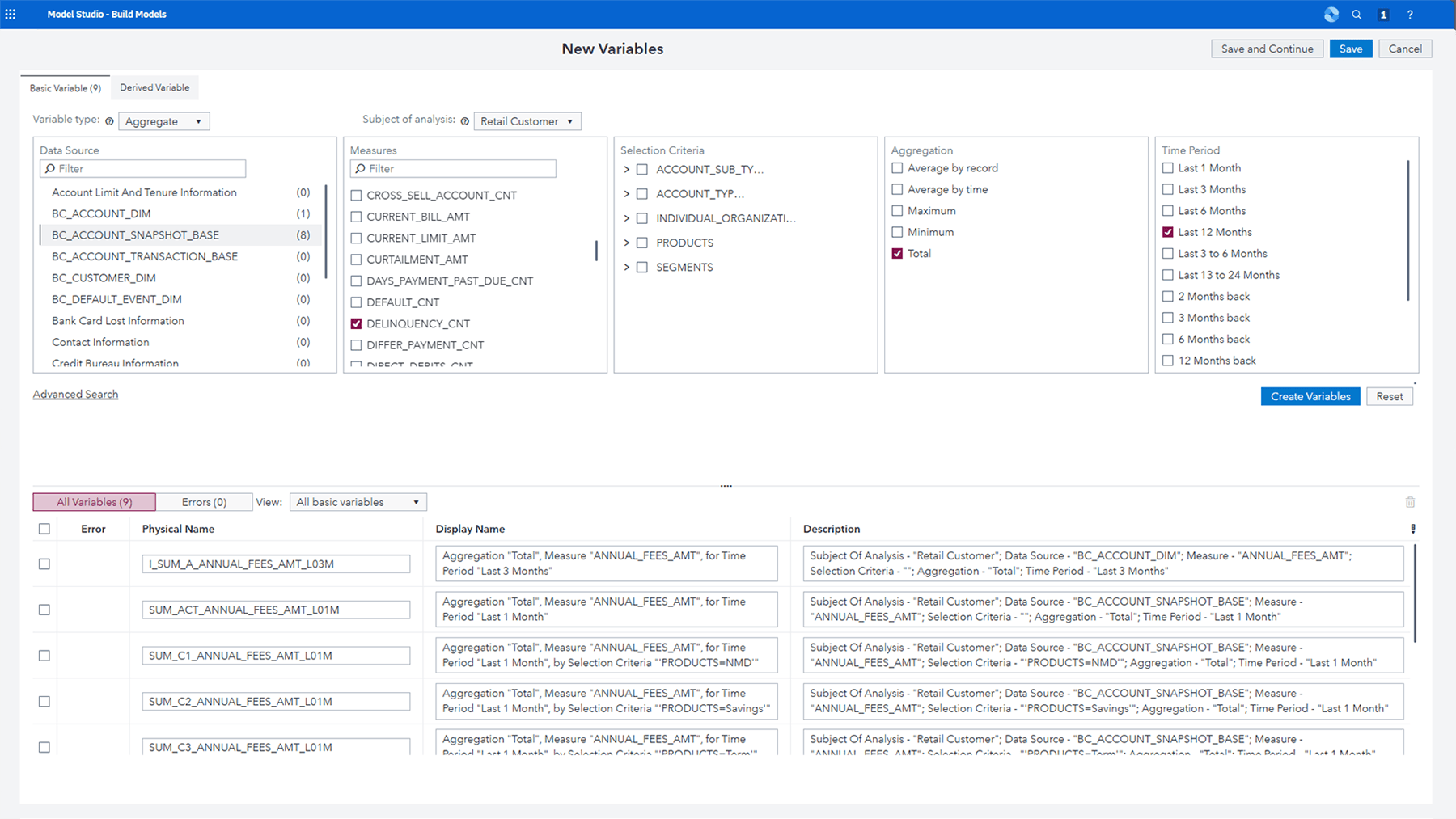
Prepare & transform data for risk modeling
Turn fragmented data into analysis-ready data sets with a collaborative, governed environment. Build and reuse data sets, engineer variables and apply transformations while maintaining full lineage, traceability and control – ensuring consistency for credit risk modeling and regulatory compliance.
-

Analyze data with automated insights
Quickly assess data quality, completeness and relationships using automated profiling and visual exploration. Identify anomalies, validate inputs and determine whether data is fit for modeling with built-in governance checks and audit flags.
-

Develop risk models with statistical & machine learning techniques
Build, compare and optimize credit risk models in a unified environment for statistical methods and machine learning. Use auto-tuning, explainability (SHAP, LIME), bias detection and champion/challenger testing to improve model performance and transparency – without recoding.
-

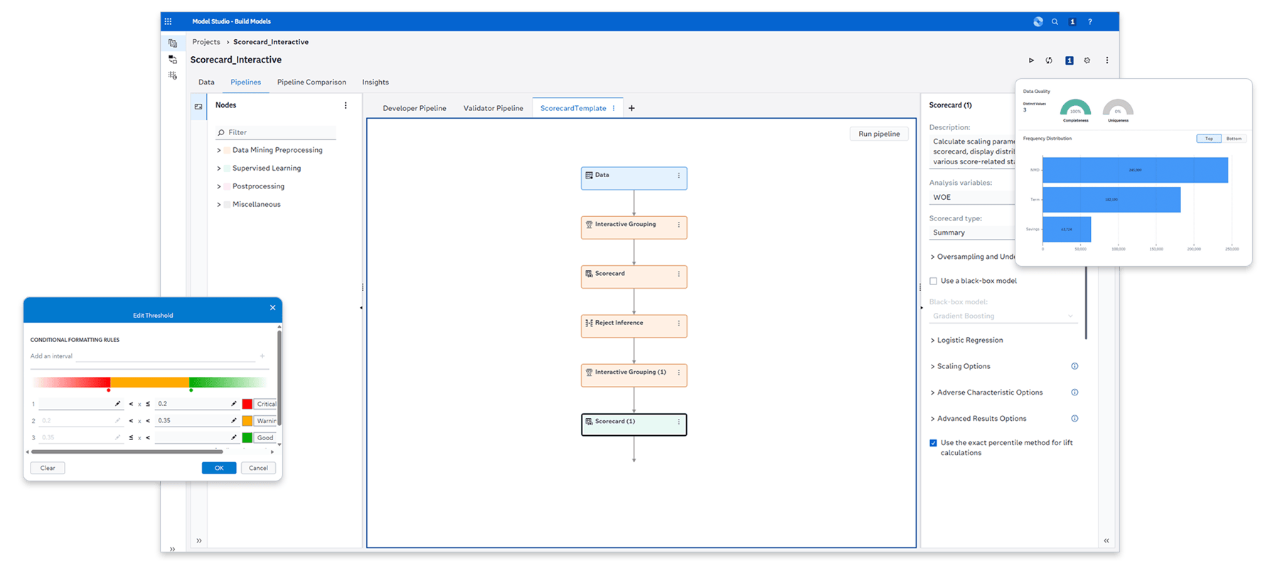
Design scorecards with interactive grouping & simulation
Create regulator-ready credit scorecards using interactive binning and weight-of-evidence (WOE) transformations. Simulate model outcomes in real time to optimize risk segmentation, stability and business performance before deployment.
-

Manage models with centralized governance, backtesting & monitoring
Store and manage all models in a centralized, governed repository with full version control and end-to-end traceability. Automate backtesting, performance monitoring and model review across the life cycle. Track stability, drift and accuracy using prebuilt KPIs, configurable metrics and automated dashboards aligned with regulatory expectations (e.g., IFRS 9, CECL, Basel).
-

Generate audit-ready model documentation automatically
Produce comprehensive, review-ready documentation across the entire model life cycle. Automatically capture methodology, data, assumptions and performance metrics to support model validation, auditability and regulatory compliance, while reducing manual effort.
Key features of SAS Risk Modeling
Data preparation & governance
Access, integrate and prepare data in a collaborative, governed environment for consistent, analysis-ready risk modeling.
- Integrate third-party, application, transactional and behavioral data.
- Maintain data lineage, project definitions and documentation.
- Standardize and enrich datasets for modeling.
- Enforce governance across data workflows.
Preprocessing & feature engineering for risk modeling
Prepare high-quality inputs using techniques aligned with credit risk best practices.
- Apply interactive grouping to manage bins and attributes.
- Use weight-of-evidence (WOE) transformations for interpretability.
- Ensure monotonicity and stability for scorecards.
- Align with regulatory expectations.
Advanced modeling & risk scoring
Develop and optimize risk models using statistical and machine learning approaches in a unified environment.
- Build credit scorecards, statistical and machine learning models.
- Run simulations and compare modeling pipelines.
- Integrate open source or custom models.
- Maintain transparency and control.
Data augmentation & modeling techniques
Improve model performance with advanced data and sampling methods.
- Apply reject inference for unlabeled or rejected populations.
- Use SMOTE and Tomek links for sampling.
- Combine statistical and machine learning approaches.
- Ensure interpretability and documentation.
Model specification & calibration
Validate model design and maintain consistent performance over time.
- Verify rank ordering using score-based bins.
- Compare development and validation data sets.
- Calibrate models as portfolios and risk profiles evolve.
- Ensure transparency and compliance.
Model monitoring & validation
Track and validate model performance with standardized metrics and reporting.
- Monitor stability, performance and drift.
- Validate inputs and calibration.
- Use dashboards and web-based reports.
- Align with BCBS and regulatory standards.
- Support SAS and BYOM models.
Centralized model governance & repository
Manage models with centralized control and life cycle visibility.
- Store models with version control and traceability.
- Enable collaboration across teams.
- Ensure consistency and governance.
Automated model documentation & audit readiness
Streamline documentation and support regulatory review.
- Generate audit-ready documentation automatically.
- Maintain a centralized model book.
- Aggregate supporting artifacts and evidence.
- Support validation and reporting.
Dedicated behavioral modeling capabilities
Model dynamic credit risk using behavioral and macroeconomic inputs.
- Support binary outcomes.
- Incorporate time-dependent and macroeconomic variables.
- Improve creditworthiness assessment over time.
How organizations use SAS for risk modeling
-


Precision in credit decisions
Banca Mediolanum uses SAS to integrate machine learning into its credit scoring, increasing model reliability and ensuring a smooth transition to stricter regulatory standards. This strategic shift accelerated their time-to-market for new products and supported a growth of over 30 billion euros in assets.
-


Accelerating credit access
By automating its manual credit risk processes with SAS, ABBANK now delivers faster loan evaluations and more precise risk assessments for millions of customers. This digital transformation has significantly improved operational efficiency while reducing the likelihood of defaults to support sustainable growth.
-


Scaling regional credit operations
By using SAS to unify its analytics and decisioning on a single platform, UOB successfully integrated a massive retail portfolio acquisition across multiple Southeast Asian markets. This standardized approach allows the bank to deploy sharper credit strategies independently, significantly improving portfolio performance and accelerating financial returns.
Chartis RiskTech100® 2025 Awards
SAS se classe deuxième au classement général, avec six victoires dans des catégories différentes.


SAS occupe la seconde place du classement mondial des 100 meilleurs fournisseurs de technologies de gestion des risques et de conformité. SAS a également remporté six catégories de prix technologiques, dont l'IA pour la banque, Balance Sheet Risk Management, Behavioral Modeling, Enterprise Stress Testing, IFRS 9 et Model Risk Management.


Related products, solutions & capabilities
- SAS® Asset and Liability Management Flexibly employ cash flow projection and valuation methods with the ability to add sophisticated behavioral models and custom cash flow logic in a cloud-native, modular and transparent solution.
- SAS® Credit Customer ManagementDetect, prevent and manage risk across the entire customer life cycle with SAS Credit Customer Management.
- SAS® Credit OriginationSimplify credit onboarding with an AI-powered platform that automates decisions, orchestrates data and integrates analytics in real time.
- SAS® Model StudioMaximize productivity and trust with a unified, scalable and collaborative machine learning platform.
- SAS® Visual AnalyticsDécouvrez et explorez les relations entre les données et partagez vos observations.
- SAS® Viya®Bénéficiez d'une intégration plus rapide des données, d'un développement efficace des modèles et d'une réduction des coûts liés au cloud.
SAS Risk Modeling frequently asked questions
What is SAS Risk Modeling?
SAS Risk Modeling is a credit risk modeling and analytics platform that enables organizations to develop, validate, deploy and monitor risk models within a governed, auditable environment.
What is credit risk modeling software?
Credit risk modeling software helps financial institutions assess the likelihood of borrower default and potential losses using statistical models, scorecards and machine learning techniques. It supports underwriting, pricing and portfolio risk management.
What does SAS Risk Modeling do?
SAS Risk Modeling allows organizations to prepare data, build and validate models, develop scorecards, perform backtesting and monitor model performance – while ensuring governance, transparency and regulatory compliance.
How does SAS support regulatory compliance (e.g., IFRS 9 and CECL)?
SAS Risk Modeling supports regulatory frameworks such as IFRS 9 and CECL by enabling model transparency, auditability and ongoing validation. It provides tools for documentation, performance monitoring and reporting aligned with regulatory expectations.
What is model risk management?
Model risk management involves validating, monitoring and governing models to ensure they perform as expected and meet regulatory standards.
How does SAS Risk Modeling support model risk management?
SAS Risk Modeling supports model risk management through automated backtesting, performance tracking, version control and audit-ready documentation.
Can I combine traditional models with machine learning?
Yes. SAS Risk Modeling supports both traditional statistical techniques and machine learning models in a unified environment, allowing organizations to compare approaches and optimize performance.
Does SAS Risk Modeling support open source models?
Yes. SAS Risk Modeling supports bring-your-own-model (BYOM) approaches, enabling integration of open source models while maintaining centralized governance and control.
What types of lending products does SAS Risk Modeling support?
SAS Risk Modeling supports a wide range of lending products, including credit cards, personal loans, mortgages and commercial lending.
Who should use SAS Risk Modeling?
SAS Risk Modeling is used by financial institutions and risk teams responsible for credit risk, underwriting, model validation, compliance and portfolio risk management.