

Solution Brief
Procurement integrity
Modernize your procurement process to maintain its integrity and reduce costs.
The issue
Improper payments and lack of oversight can have a direct effect on purchases of goods and services or commissioning of projects from third parties. For example, not following the tender process creates gaps for irregularities. Problems also arise when payment claims aren't delivered or are inferior to what the order specified. Internal mistakes create another layer of issues. With losses estimated at 1% to 4% of total procurement spending, the ramifications, if left undetected, include an increase in unnecessary spending, operational disruption, reputational risk, legal action and, of course, financial loss.
Weak controls and improper payments lurk throughout the procurement life cycle and are difficult to find. On average, these vulnerabilities are detected more than a year after having been initiated – if they are identified at all. Clearly, it's important to detect irregularities as quickly as possible. Manual audits rely on an auditor's skill to detect fraudulent behavior from a vast array of information – but this only happens at one point in time, so it doesn't provide continuous monitoring for detection and prevention. How can you minimize risks earlier and prevent procurement abuse

The challenge
Data siloes
Growing volumes of siloed data and an increasingly digital procurement process can lead to weakness in controls, improper payments and corruption.
Manual oversight
Manual oversight occurs infrequently and fails to capture improper payments made between procurement cycles or those that represent long-term historical trends.
Inefficient operation controls
Inefficient operation and process controls may lack third-party (e.g., supplier) data capture and analytics that dig deeper than simple rules-based analysis.
Process complexity
Complex, decentralized procurement processes leave more room for errors and abusive loopholes in the system.
The possibilities
What if you could continuously monitor your contracting and procurement processes to proactively detect, investigate and mitigate irregular activities?
With SAS Payment Integrity for Procurement, you can:
(Create predictive models; Capitalize on data and AI; Use integrated forensic capabilities; Score risk on transactions; View entity networks in real time )
Our approach
Our modular approach to procurement integrity uses automation to accelerate the process and free up valuable resources for more consistency. And by bringing together data from disparate external sources, you gain better situational awareness.
We deliver software and services to help you:

Identify and combine information
Identify and combine information from different systems, agencies and third-party data sources to resolve entities and augment knowledge about suppliers, people and products.

Employ a combination of analytical techniques
Employ a combination of analytical techniques, such as clustering, segmentation, pattern recognition and associations, to determine or predict the overall risk posed by each payment, invoice, supplier or purchase order.

Improve audits and investigations by integrating data
Improve audits and investigations by integrating data with other types of intelligence to manage a workflow that reflects organizational objectives. Reporting provides information to key decision makers in the form of dashboards, portals, web analytics, mobile reporting, briefings and alerts.
Case studies
Public utility company
Discovered excessive multiple invoices and inflated and duplicated payments – costing over US$700 million. And 600 employees were identified as having an active interest in suppliers.
Government institution
Uncovered employee collusion with a large supplier paid over $300 million. Forensic analysis revealed multiple and split invoicing, which continuous monitoring could have prevented – saving more than $16 million.
Energy provider
Identified $500 million paid to suppliers without receiving goods and found 25 ghost employees.
Utility company
Analyzed three years of supplier data and found conflicts of interest in 10% of employees, $300 million in collusive spending and immediate savings of over $16 million in unpaid duplicate invoices.
SAS difference
In conjunction with your existing safeguard policies, SAS helps you make quick decisions about whether to stop invoices, payments or purchase orders. SAS detects even the most obscure instances of error or abuse – and reduces disruption and delays due to low-risk items – so there’s minimal impact on customer service.
Only SAS offers:
Domain expertise
- Our procurement models from multiple industries accelerate time to value. These models provide objective, data-driven risk screening to identify high and low-risk purchase orders, suppliers, invoices and payments, so users can remediate high-risk processes and secure financial positions quickly.
Continuous, automated monitoring
- We target wasteful or high-risk billing and purchase orders by incorporating data from a variety of sources. So you can identify events that require closer review without delaying other event processing. Predictive analytics finds and minimizes false positives.
Automated data analytics/reporting
- SAS provides descriptive reasons why an event occurred or an alert was generated. This broadens the impact of analytical outcomes across your organization. Go beyond individual invoice or payment views to analyze all related activities and entity relationships at a network dimension. Once linkages are established, factor them into risk-scoring models.
Empower users
- With automation in data management, triage and workflow, operations are streamlined so that analysts can make fast decisions via an easy investigative interface. Review all relevant data, perform advanced searches and apply temporal or geospatial methodologies from a single solution.
-
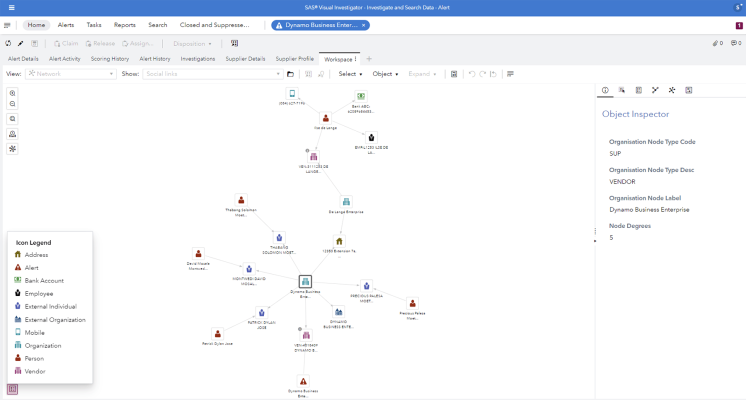
SAS Payment Integrity for Procurement social network analysis
-
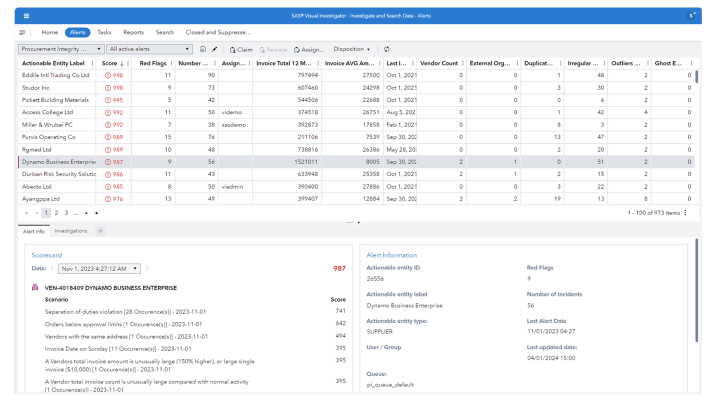
SAS Payment Integrity for Procurement queue
-
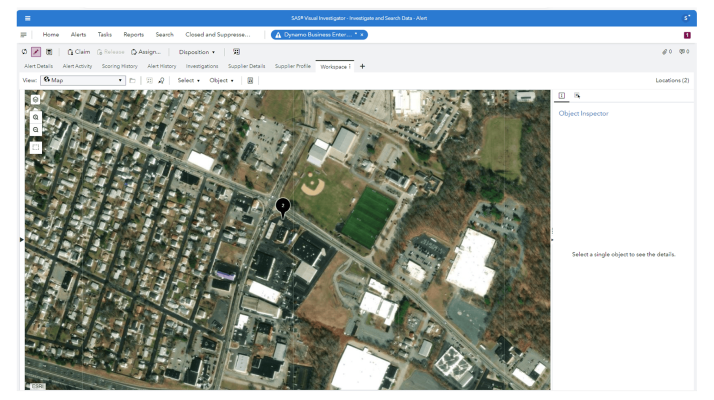
SAS Payment Integrity for Procurement supplier locator
-
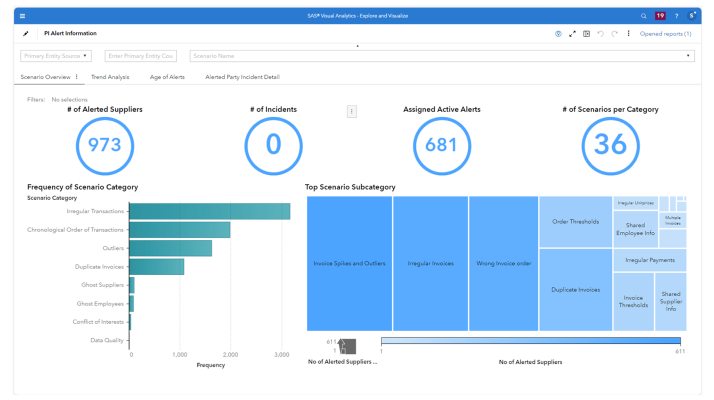
SAS Payment Integrity for Procurement supplier profile
SAS facts
>60
countries with SAS health care customers
100%
Fortune Global 50 health care and life sciences companies that are SAS customers
>1,700
health and social services customers worldwide